
Every Breath
A short, 2.D narrative platformer game made in Unreal Engine 5
Role: Co-Lead Systems/Gameplay/Level Designer, Lead Narrative Designer, Writer, Co-Lead QA, Audio Lead, QA Lead

Every Breath is a 2.5D narrative survival platformer where players navigate their way out of an underground bunker and cave system while managing limited oxygen, time, and movement under pressure to bring their dying mother to see sunlight for the last time. Platforming and exploration are deliberately constrained to emphasize physical strain and scarcity, turning survival into a series of calculated tradeoffs on taking the longer but easier route, or the tougher but shorter route.
Oxygen functions not only as a survival resource but also as a narrative currency: choosing to speak with the player character’s mother, who has Alzheimer’s, through optional dialogue consumes precious air, forcing players to weigh emotional connection against the risk of running out. By tying storytelling directly to resource management, the game explores how care, memory, and survival collide when every decision has a cost. Depending on player decisions, they will reach their mission of arriving when the sun is still up, or when it has already gone down.

For our game's final expo submission polish, we are animating the characters to sit down by the campfire and putting an oxygen mask on their faces.
For our game's final expo submission polish, we are animating the characters to sit down by the campfire and putting an oxygen mask on their faces.

Gameplay after bunker tutorial area leads to first level of cave more rocky and slippery, less plant life, though some bioluminescent plants caused by radiation can be seen.

Bunker tutorial level to set the context of the game - the boy and mother are leaving the safety of their bunker to go on a quest to see the sunlight.

Alternate/easier path through tunnel in base camp level (lowest cave level)
Gameplay after bunker tutorial area leads to first level of cave more rocky and slippery, less plant life, though some bioluminescent plants caused by radiation can be seen.
Narrative/Design Overview
Game Design Journal
We started by designing a playable paper prototype of our game to see how players responded to resource management and plot points
Playtesting Data
Playtesting Focus & Results (Paper Prototype)
-
What we tested for
-
Whether oxygen as a shared resource created meaningful tension between survival and narrative choice
-
If players understood that talking with the mother consumes oxygen and treated dialogue as a deliberate tradeoff
-
How players navigated 2.5D platforming under pressure, especially when resources were scarce
-
Whether emotional engagement increased when narrative moments had mechanical consequences
-
-
What we found
-
Players clearly understood oxygen as a high-stakes resource and quickly adapted their behavior around it
-
The oxygen-cost dialogue successfully reframed conversation with the mother as a meaningful decision, not a passive story beat
-
Players reported heightened tension when choosing to engage with narrative moments despite the survival risk
-
Platforming felt more deliberate and cautious under oxygen pressure, reinforcing the intended pacing and tone
-
Overall, tying narrative interaction directly to survival mechanics increased emotional weight, player agency, and immersion
-
Our game design documentation showing changes made after the prototype, prototyping using FIGMA, game loops, audio design, and systems checklist
Our game macro document showcasing the creative vision for our project: mechanics, narrative & design goals, assets, and emotional beats.
SFX Checklist I designed and wrote so that sound and music hit the same emotional beats as gameplay design
We carried out formal bug and playtesting on a large screen with a facilitator and noted down results. We created a script for the facilitator and instructions for the playtester
Our overall reports. We changed our usability report format as we got closer to the final iteration of our project so we could be more descriptive about issues and list them out clearly. Data is compiled here from our beta build as well.
Our final playtester survey data
We carried out 10+ playtests!
Playtesting Insights & Iteration Summary
-
What players reported
-
Oxygen scarcity was immediately understood as the primary source of tension and shaped moment-to-moment decision-making
-
Players felt strong emotional pressure when choosing whether to engage in dialogue with the mother, especially once they realized it consumed oxygen
-
Early playtests revealed confusion around when and how oxygen was being spent, particularly during narrative interactions
-
Some players initially treated dialogue as optional flavor rather than a mechanically meaningful choice
-
Platforming under resource pressure heightened caution and stress, but pacing occasionally felt uneven or overly punishing
-
-
What we changed
-
Clarified the oxygen cost of dialogue through clearer feedback and framing, reinforcing it as an intentional survival tradeoff rather than a hidden penalty
-
Adjusted oxygen tuning and consumption rates to better balance challenge with player agency, reducing frustration while preserving tension
-
Refined level pacing and platforming flow to ensure moments of narrative choice occurred at emotionally meaningful, but survivable, points
-
Reframed the mother’s dialogue to emphasize its emotional weight, reinforcing why players might choose to spend oxygen despite the risk
-
Iterated on UI and usability elements to better communicate resource state and consequences, based directly on usability feedback
-
-
Overall outcome
-
Later playtests showed stronger alignment between player behavior and design intent
-
Players made more deliberate, emotionally motivated decisions rather than optimizing purely for survival
-
The integration of narrative and resource management became clearer, resulting in higher emotional engagement and perceived agency
-
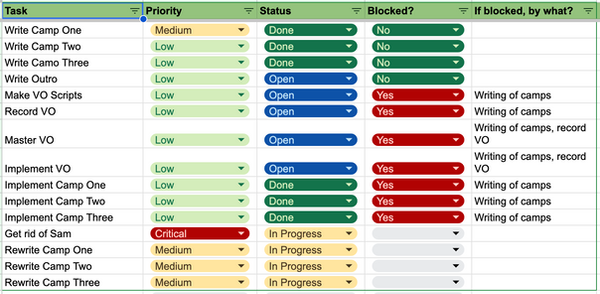
Example of production Checklist sheet we regularly updated for art, design, engineering, and narrative (writing)

