
USCult
A board game made for the assignment "Meaningful Play" at USC
Role: Designer, Playtester/Usability, Writer
USCCult is a fast-paced social deduction party game set on a college campus, where players are secretly members of a cult attempting to recruit others without being exposed. Across structured rounds of discussion, investigation, and accusation, players must read social cues, manage limited actions, and decide when to reveal information or sow doubt. The streamlined rules emphasize clarity, momentum, and player-driven tension, allowing paranoia and persuasion to emerge naturally at the table. Victory comes from successfully converting or exposing players at the right moment, rewarding sharp observation, confident bluffing, and strategic timing.
Iteration 1
Summary of the first iteration of our game: Cat Cult is a fast-paced social deduction party game where players take on the roles of cats secretly belonging to rival cults. Through bluffing, deduction, and well-timed accusations, players attempt to expose opposing cultists while protecting their own. Simple rules and hidden information create moments of paranoia, humor, and dramatic reversals, encouraging lively table talk and emergent social play.
So-- what worked and what didn't work?
What the Original Game Looked Like
The original version of the game began as a looser social deduction experience with heavier reliance on hidden rules and situational mechanics. While it successfully encouraged discussion and suspicion, early playtests showed that players often struggled to understand action options, information visibility, and how close the game was to ending. This resulted in hesitation, uneven pacing, and rounds that sometimes dragged without clear escalation.
Playtesting Results & Player Survey Questions Round 1
What We Tested For
-
Whether the game created tense, conversation-driven social deduction
-
If players clearly understood what actions they could take and when
-
Whether accusations felt meaningful and decisive, rather than stalling the game
-
Overall pacing, clarity, and accessibility for first-time players
What Worked
-
Players consistently engaged in active discussion and bluffing, indicating the social deduction core was effective
-
Hidden roles successfully created paranoia and suspicion early in each round
-
Accusations generated strong emotional reactions and table energy
-
Players enjoyed reading behavior and forming temporary alliances rather than relying on mechanics
What Didn’t Work
-
Some players were unclear on available actions and turn sequencing, causing hesitation
-
Confusion around public vs. hidden information slowed decision-making
-
Accusations did not always feel decisive enough, leading to rounds running long
-
Certain mechanics distracted from social play rather than reinforcing it
What We Iterated On
-
Turn structure clarity: Reduced confusion around available actions each round
-
Information visibility: Clarified what was public vs. hidden to reduce hesitation
-
Pacing & escalation: Tightened win conditions so accusations carried more weight
-
Rule simplicity: Removed or merged mechanics that distracted from social play
Playtest Survey Focus (New Iteration – USCCult)
What we asked players:
-
How clear the rules, turn flow, and available actions felt
-
Whether public vs. hidden information was easy to understand
-
If players felt confident making accusations
-
How the pacing felt across a full game
-
Whether the game encouraged discussion, bluffing, and suspicion
-
What moments felt confusing, slow, or especially engaging
What We Found from Playtesting
What worked:
-
Players consistently engaged in active table talk and bluffing
-
Accusations felt tenser and more deliberate than in earlier versions
-
Clearer structure led to more confident decision-making
-
Social dynamics, not rules, became the primary driver of tension
What still surfaced:
-
Some edge cases still caused brief hesitation
-
Players wanted even stronger signals of endgame pressure
-
Groups varied in how aggressively they accused, affecting pacing
Key takeaway:
The redesigned rules successfully shifted focus away from rule interpretation and toward player psychology and social interaction, validating the core direction of USCCult as a readable, high-energy social deduction game with plenty of chance to sabotage rival players.
Why We Redid the Game
Playtesting data and design journal reflection revealed that mechanical ambiguity was competing with social play. Instead of focusing on reading players and bluffing, participants were frequently checking rules or second-guessing procedures. Our core takeaway was that the game needed to be rebuilt around clarity, momentum, and decisive social moments, rather than layered mechanics.
What We Changed Across Development
-
Rebuilt the game around a clear, structured turn flow to reduce hesitation
-
Clarified public vs. hidden information so players could act with confidence
-
Removed or merged mechanics that distracted from table talk
-
Tightened win conditions to ensure accusations felt meaningful and final
-
Shifted design emphasis from rules mastery to player psychology and timing
These changes were driven directly by observed friction in playtests and reinforced through iterative rulebook rewrites documented in the design journal.
Tides of Fortune
A game mod of "Up the River" with a more piratey Twist!
Role: Gameplay Designer, playtester, COmponent Designer
 |  |  |
|---|---|---|
 |  |  |
The game was made as a modification to the board game Up the River.
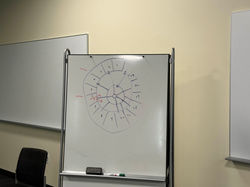
Tides of Fortune is a competitive pirate board game where players sail a rotating whirlpool to collect gold, fight rivals, and survive an expanding kraken. On each turn, players move based on a coin flip, resolve combat with other players or the kraken using single-use dice, collect treasure, rotate part of the board, and advance the kraken’s spread. Players may exit the board at any time to bank their gold; once all players have banked, the richest pirate wins
The first playtest revealed that Pirate’s Plunder successfully conveyed a pirate fantasy, but suffered from excessive complexity, unclear rules, and an undefined end condition. Players were frequently confused by board rotation, kraken behavior, combat edge cases (three-way battles, shared tiles), and navigation between rings. The kraken in particular lacked clear purpose and incentives, which led players to avoid interacting with it. The game also ran too long, with slow pacing and no clear conclusion, undermining tension and risk-reward dynamics
What we changed:
Based on these findings, the team focused on simplification and clarity. We identified the need to redesign the board for clearer rotation, clarify movement and combat rules, and rethink the kraken’s role entirely. Early decisions included speeding up kraken expansion and player movement, removing unclear board markings, simplifying or removing confusing mechanics (like coin flipping), and reworking the win condition to eliminate contradictory goals. These insights directly informed a major systems overhaul going into the second iteration
The second round of playtesting showed that the core systems were now working, but complexity had shifted from being unclear to being overloaded. Players understood the game better, but struggled to remember too many rules and special cases. Some emergent strategies—like waiting safely in outer rings—proved fun and intentional, while others highlighted lingering issues, such as weak incentives to enter the center early and awkward physical components (coins, board rotation). Importantly, players responded positively to having more strategic agency over board rotation and kraken placement
.
What we changed:
In response, we streamlined aggressively. We made the kraken and board rotation mandatory and deterministic, replacing card-based randomness with player-driven decisions and a single d6 roll. Coin-flip advantages and separate kraken combat systems were removed entirely. Kraken mechanics were unified, the kraken pot was seeded with gold at the start to incentivize early risk, and the rulebook was reorganized with a clear turn order. These changes reduced cognitive load while preserving strategic depth, resulting in a faster, clearer, and more focused play experience
Game design journal showing our design process through the project
House of Horrors
A board game made during USC's Foundations of Game Design Course as a mod of the board game "Up the river"
Role: Producer, Designer


Our game is made for a minimum of 3 players and ideally, a total of 5 players where one player controls the house (monsters) against the players trying to reach the exit. Each player character has unique abilities and movement/interaction points inspired by TTRPG game design.
House of Horrors was initially named "Haunted Manor," which we changed after completing the game. We play-tested the game using iteration cycles and real-time tester feedback. The game features 3D monster tokens and other booby trap tokens to represent obstacles on the game board. The board game medium challenged me in creating game balance and making sure game mechanics reflect the theme of the game. We had to focus on player cooperation and rivalry to ensure enjoyable interactions. We included interactions that created emergent gameplay for greater interactivity and replayability.
Teammates:
Kyle Tang, Kai Riley, Tobi Adefidiya, Nicolas Shi, and myself, Trina Guharoy
